
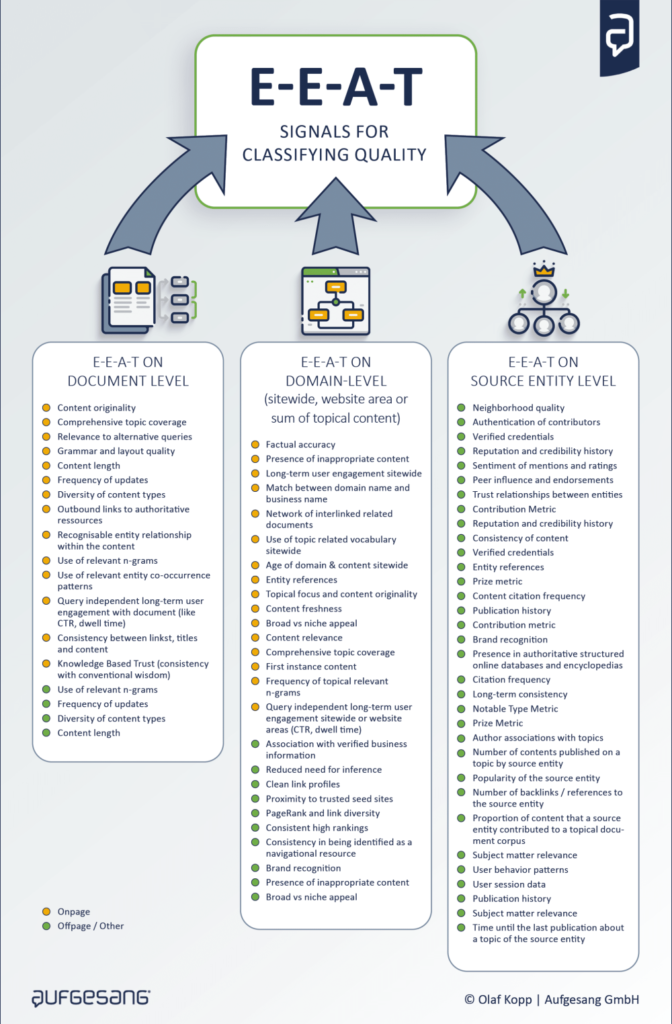
EEAT (Experience, Expertise, Authoritativeness, Trustworthiness) is a system of factors that evaluate the quality of content, domain, and source. These signals are key in search engine rankings, especially for pages that require a high degree of trust: medical, financial, or expert sites. Digging deeper into this topic allows you to understand how content can meet the expectations of both users and Google algorithms.
EEAT at document level
1. Originality of content
Content that repeats existing information rarely ranks highly. Unique research, case studies, and original findings help increase the value of a document.
2. Complete coverage of the topic
Complete coverage of the topic increases the user’s time on the page and reduces the bounce rate. Deep immersion in the topic with analysis of the nuances plays an important role.
3. Relevance to alternative queries
A document that takes into account different formulations of one query receives more organic traffic. The semantic core helps to take into account such alternatives.
4. Quality of grammar and layout
Literate text with a logical structure increases trust. This also applies to neat visual design: subheadings, sections, quotes.
5. Content Volume
Google’s algorithms are more likely to rank higher articles with a lot of text if it is filled with value rather than “fluff”.
6. Frequency of updates
The relevance of the data is checked based on the freshness of the publication. Regular updates increase the chances of high positions.
7. Diversity of content types
Infographics, video, audio, and text on one page increase engagement and dwell time.
8. Outgoing links to reputable resources
Links to reputable sources confirm the reliability of the information, especially when it comes to scientific data.
9. Link to recognizable entities in content
Mentioning well-known brands, names or terms makes the text more relevant and trustworthy.
10. Using relevant n-grams
High-frequency phrases related to a topic help search engines better understand the content of a page.
11. Using patterns of co-occurrence of entities
Phrases and terms that frequently appear together in thematic texts add semantic depth to the content.
12. Long-term behavioral factors
CTR (click-through rate of snippets) and time spent on page are important signals that improve ranking.
13. Consistency between links, titles and content
Inconsistency between the title and content leads to negative behavioral signals.
14. Trust Based on Knowledge
Data that aligns with conventional wisdom is less likely to be questioned by audiences and algorithms.
EEAT at the domain level
1. Factual Accuracy
Content that is filled with errors or false information undermines the credibility of the entire site.
2. Having Inappropriate Content
Google penalizes sites that publish illegal or controversial content.
3. Long-term behavioral factors
If users return to the site frequently or spend a lot of time on it, this signals a high level of trust.
4. Match your domain name to your business
A clear and memorable domain name increases brand awareness.
5. Network of interconnected documents
Links between articles within the site form a network structure that helps to better understand the thematic focus of the resource.
6. Use topic-relevant vocabulary
Repeated key phrases and terms strengthen semantic connections.
7. Domain and Content Age
Older domains are often perceived as more trustworthy.
8. Mentions of entities
A site that is mentioned on other resources receives additional trust signals.
9. Thematic focus
Narrow specialization is often perceived as an indicator of expertise.
10. Broad vs. Niche Focus
Both niche and general purpose sites can be successful if they are approached with quality.
EEAT at source level
1. Author Authentication
Author information adds transparency. Authoritative biographies increase trust.
2. Reputation History
If an author or source is frequently cited, this becomes a plus for the content.
3. Influence and approval from colleagues
Feedback from other professionals strengthens your authority.
4. Contribution metrics
The number and quality of an author’s publications in a particular field.
5. Presence in structured databases
Mentions in resources such as Google Scholar, Wikipedia or LinkedIn increase trust.
6. Popularity of the source
The higher the number of visitors and citations of a site, the higher its authority.
Why is EEAT important?
Google uses these signals to filter out low-quality content. Site owners and authors should consider the recommendations to increase trust with both users and search engines. A thorough approach to content creation, consideration of all EEAT levels, and regular monitoring will help ensure long-term success.